TL;DR: What should I charge for salon services? Divide what your studio needs in a year by the hours you actually sell, multiply that hourly rate by the time each service holds your chair, add product and card fees, round up, and check the result against five studios near you.
You priced your menu the week you opened. You looked up three salons nearby, picked a number a little under the middle, and hoped. Now you are booked most days, still short at the end of the month, and you cannot say which service is the problem.
That is what pricing by feel costs. Here is the math that replaces it: four steps, a calculator, and one evening.
Why copying the salon down the street fails
Their price is built on their rent, their hours, and how full their book is, and you know none of those numbers. It can be right for them and wrong for you.
Feel fails a different way. It prices the minutes the client sees and forgets the consult, the processing, the clean-down, and the empty Tuesday. A price has to pay for every minute the chair is closed to anyone else, and for the hours nobody books.
Step 1: What does your studio need in a year?
Write down two lines.
- Your pay. What you want to earn in a year, before tax. It is the easiest line to shave. Do not.
- Your fixed costs. Rent or booth rent, insurance, software, education, marketing, and last year’s total of any commission your booking app took on new clients. Leave out product. It goes on each service in step 3.
Set the pay line high enough to cover tax. If you work for yourself, self-employment tax, which covers your Social Security and Medicare, is 15.3%, and income tax is a separate bill. Ask your accountant what to set aside.
Step 2: How many hours do you really sell?
Not the hours you are open. The hours a client is in your chair and pays.
- Weeks you work in a year, after holidays, vacation, and sick days.
- Hours a week you are open for clients.
- How full you really are: the share of those hours booked by clients who showed up. Use last month, not your best week. For a forward look, Rezzy’s Reports shows how much of your next two weeks is already booked, as a share of your open hours.
Multiply the three. Divide step 1 by the answer. That is your chair-hour rate: what every sold hour has to earn after product and card fees.
| Worked example | Amount |
|---|---|
| Your pay, before tax | $60,000 |
| Fixed costs | $24,000 |
| What the studio needs | $84,000 |
| Weeks worked | 48 |
| Open hours a week | 35 |
| How full | 75% |
| Hours sold (48 × 35 × 75%) | 1,260 |
| Chair-hour rate ($84,000 ÷ 1,260) | $66.67, call it $67 |
These are example numbers, not benchmarks. Use yours.
The fill line is the one that hurts. Price as if you are fully booked and the same studio needs only $50 an hour ($84,000 ÷ 1,680). Every service comes out a quarter too cheap, and the gap shows up as a short month you cannot explain.
Price it where the minutes live. In Rezzy each service carries its duration, its buffer, and its price, and clients book from that same menu. Take a booking today.
Step 3: What to charge for each service
Price = chair-hour rate × chair hours + product + card fee, rounded up.
- Chair hours run from the client sitting down to the chair being ready for the next one. Count the consult, any processing time you cannot give to someone else, and the clean-down.
- Product is what one visit uses: color and developer, foils, gloves, wax, disposables. Measure it once.
- Card fee is what your processor keeps. Stripe’s standard US rate is 2.9% + 30¢ per domestic card payment. Square’s Free plan charges 2.6% + 15¢ when a card is tapped, dipped, or swiped in person.
Here is the example studio at $67 an hour, with 15 minutes of clean-down after each service. The floor is the lowest price that pays the rate, the product, and the card fee (Stripe’s rate, here).
| Service | Chair minutes | Time at $67/hr | Product | Card fee | Floor | Price |
|---|---|---|---|---|---|---|
| Blowout | 45 | $50.25 | $2 | $1.87 | $54.12 | $55 |
| Cut and style | 60 | $67.00 | $3 | $2.40 | $72.40 | $75 |
| Single-process color | 90 | $100.50 | $15 | $3.76 | $119.26 | $120 |
| Partial highlights | 135 | $150.75 | $25 | $5.56 | $181.31 | $185 |
In Rezzy, chair minutes are two fields on the service: Duration is the time the client sees, and Buffer after is the clean-down nobody can book into (set up your services).
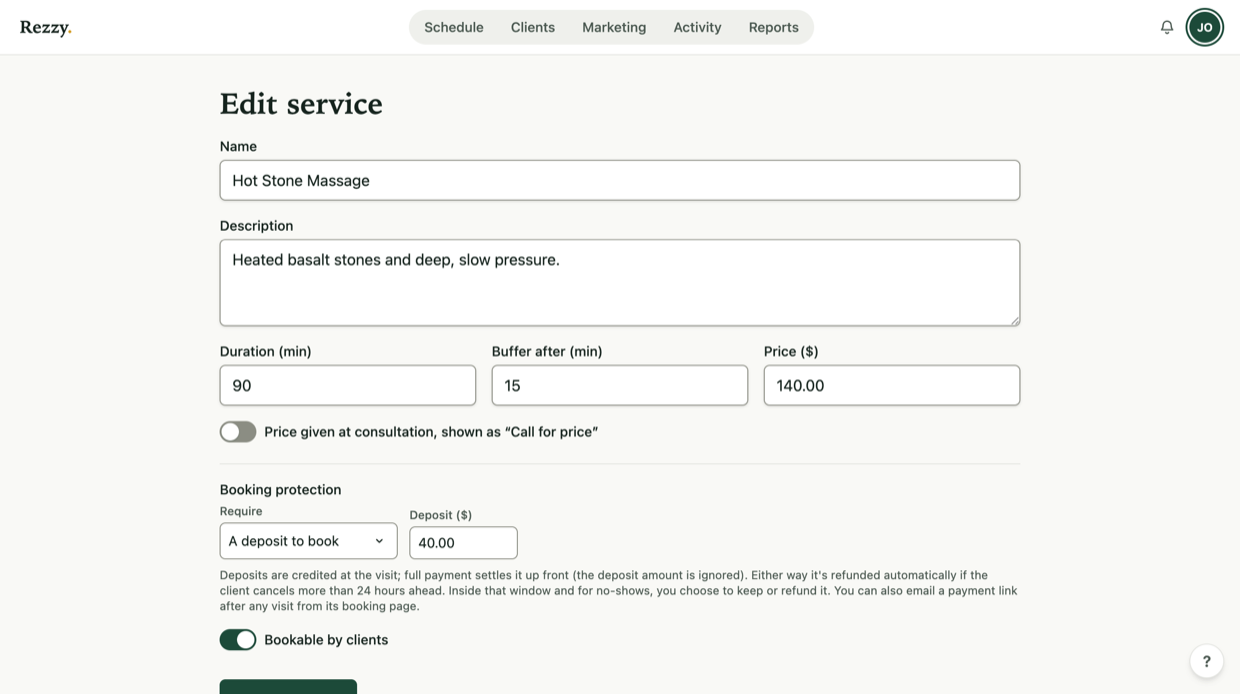
Duration plus buffer is the chair time you price. Here, 105 minutes.
Step 4: Check your price against local rates
Your floor tells you what you need. The market tells you what clients will pay.
Pick five nearby studios your clients would really choose between, doing the same work at a similar level. Write down their prices for your three busiest services, from their booking pages or the services on their Google Business Profile. Then compare.
| Your floor is | What it means | What to do |
|---|---|---|
| Below the local range | You can charge more than you need | Price inside the range. The gap is your margin. |
| Inside the range | Your math and your market agree | Price at your floor or just above it |
| Above the range | Your costs, hours, or minutes are the problem, not your price | Fill more hours, cut a fixed cost, or drop the service. Never price under your floor. |
You do not need to be the cheapest studio on the list. You need a price that pays you, inside a range clients already accept. If you price tips into your services on purpose, compare your prices with theirs plus a tip; should you take tips at a salon weighs that choice.
Does your price pay you a fair wage?
Divide your pay line by every hour you work in a year, admin included. The example studio works 48 weeks of 35 open hours and 5 admin hours: $60,000 ÷ 1,920 = $31.25 an hour.
The Bureau of Labor Statistics puts the median hourly wage at $17.21 for hairdressers, hairstylists, and cosmetologists, and $18.37 for barbers, in May 2025. Those figures include tips and leave out self-employed workers. Your pay line has no tips in it. If your number comes out near or under those, your prices pay you no more than a median employee earns with tips, and you carry all the risk. Go back to step 1 and raise the pay line.
Checked October 5, 2026 against the IRS, the Bureau of Labor Statistics, Stripe, and Square. Rates change; the linked pages are the source of truth.
Which of your services pay the least per hour?
Now run the math the other way on the menu you have: price minus product and card fee, divided by chair hours. That is what each service really earns per chair hour.
This is the example studio’s menu before step 3:
| Service | Price now | Product | Card fee | Chair minutes | Earns per chair hour |
|---|---|---|---|---|---|
| Blowout | $45 | $2 | $1.61 | 45 | $55 |
| Cut and style | $75 | $3 | $2.48 | 60 | $70 |
| Single-process color | $110 | $15 | $3.49 | 90 | $61 |
| Partial highlights | $185 | $25 | $5.67 | 135 | $69 |
The cut and the highlights clear the $67 rate. The blowout and the color do not, and the other two were quietly paying for them. That is where the new $55 and $120 came from.
Fix the lowest earner first. Usually that means raising it. The price increase calculator shows how many clients you could lose and still bring in the same money. Then announce the rise with a date. If the service cannot go up, look at its minutes: a blowout that holds the chair for 45 minutes because the clean-down is slow has a time problem, not a price problem.
Rezzy’s Reports lists your top five services by revenue under What’s working? Revenue tells you what sells. Chair hours tell you what pays.