TL;DR: How to get more Google reviews for your studio comes down to asking every client the same way, at the same time, right after their visit, with no gating and no incentives.
If you run a boutique studio, you already know reviews matter more than almost anything else for showing up in local search. What most owners don’t have is a system for actually asking, so the reviews trickle in randomly instead of steadily. Here’s how to fix that without breaking Google’s or Yelp’s rules, or the FTC’s.
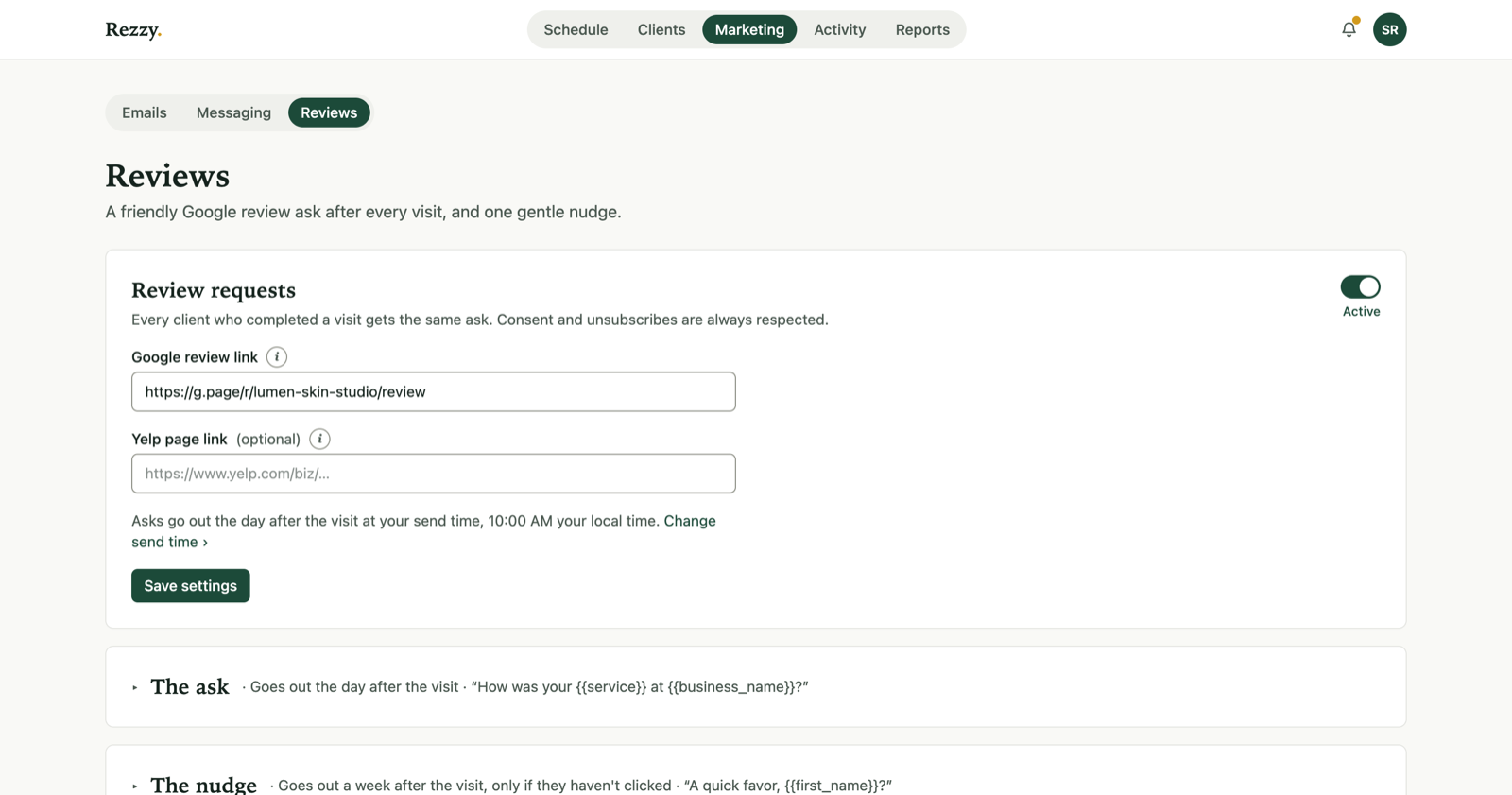
Rezzy asks the same way every time: one tap after a completed visit, no gating.
Why do Google reviews matter so much for local ranking?
Google’s local pack and Maps ranking weigh review count, review recency, and average rating alongside proximity and relevance. A studio with 60 recent reviews at 4.8 stars consistently outranks a comparable studio with 12 reviews from two years ago, even if the older studio has been open longer. Recency matters almost as much as volume: Google’s algorithm favors businesses that are still generating reviews now, not ones that got a burst of them once and stopped.
That’s the practical reason a steady drip of new reviews beats a one-time push. A studio that asks every client, every week, builds a rolling base of recent reviews that keeps compounding, while a studio that only asks occasionally plateaus. Reviews also do double duty: they influence ranking, and they influence the click-through and booking decision once a prospective client actually sees your listing. It’s the same logic behind cutting client no-shows: systems beat memory, every time.
When is the best time to ask a client for a Google review?
Ask the day after the visit, not in the moment and not weeks later. Right after a service, most clients are still in the chair or rushing to their next thing, and asking feels transactional. Wait too long and the appointment fades from memory, and so does the motivation to write anything.
The day-after window works because the experience is still vivid enough to describe specifically (“loved my color, Sarah really listened to what I wanted”) rather than generic (“good service”). Specific reviews also read as more credible to future clients and, anecdotally, tend to rank higher in relevance for people searching your specific services.
A second, gentler nudge about a week later catches the clients who meant to leave a review and forgot, without turning into nagging. Two touches, spaced out, outperforms either a single ask or a barrage of reminders.
| When | What | Why |
|---|---|---|
| Day after the visit | Direct ask, “leave us a Google review” | Experience is still fresh, feels timely not pushy |
| ~1 week later, only if no click yet | One gentle follow-up | Catches people who meant to and forgot |
| Never again after that visit’s window | Stop asking for that visit | Repeated asks read as nagging and can prompt clients to opt out entirely |
Tired of chasing reviews by hand? Rezzy asks every client for a Google review automatically, on the same compliant schedule, every time. Take a booking today.
How do you ask every client without it becoming a manual chore?
Doing this by hand doesn’t scale past a handful of clients a week. The manual version looks like remembering which clients came in yesterday, finding their email or number, and writing a personal note, every single day, forever. Most owners try it for a month and quietly stop.
The systematic version is a short series tied to your booking calendar, not your memory:
- Mark the visit complete. Your booking system already knows who showed up and when.
- Trigger the ask automatically the next day, at a consistent hour, with a link straight to your Google review page.
- Send one follow-up about a week out, only to clients who haven’t clicked through yet.
- Stop there. No further reminders for that visit, and no reminder at all if the client already clicked.
Rezzy does exactly this, alongside the other emails that send themselves at the right moment in a client’s life, once a visit is booked: it watches for completed visits and sends the ask and the single follow-up on your schedule, so it happens every time instead of when you remember. The setup is a paste-your-link-and-flip-a-switch job; the step-by-step guide has the clicks. If you’re tracking clients on a spreadsheet or in your head, start today and let the review ask run itself in the background.
What should you actually say when asking for a review?
Keep it short, specific about the ask, and give the client an easy out if something went wrong. Here are two email templates and one text template you can use or adapt directly.
Initial ask, email
Subject: How was your visit at [Studio Name]?
Hi [First Name],
Thanks for coming in! If you enjoyed your visit, a quick Google review would mean the world to us. It takes about a minute and helps neighbors find us.
[Leave a Google review]
Something not right? Just reply to this email and we’ll make it right.
Follow-up, email, sent about a week later, only if no click yet
Subject: A quick favor?
Hi [First Name],
Just a gentle nudge: if you have a minute, a Google review helps small studios like ours more than you’d think.
[Leave a Google review]
Already left one? Thank you, and please ignore this. Something not right? Just reply and we’ll make it right.
Text version, day after visit
Hi [First Name], thanks for coming in yesterday! If you have a minute, we’d love a quick Google review: [link]. And if anything was off, just reply here and we’ll sort it out.
Notice what’s missing from all three: no mention of a discount, no “only if you loved it,” no rating scale to fill out first. The ask is the same for every client, and the “something not right, reply and we’ll make it right” line quietly gives unhappy clients a private path to complain instead of a public one, without you ever having to filter who gets the ask.
What’s the difference between review gating and a compliant ask?
Review gating is when a business screens clients before asking, usually with a private rating question, and only routes the happy ones to a public review site while happy clients get filtered away from ever posting anywhere the score is bad. It sounds harmless (why would you ask an unhappy client to review you publicly?) but it’s a form of review manipulation, because it deliberately skews what the public sees.
Google banned review gating outright in 2018, and it’s grounds for having reviews removed or a listing penalized if caught. The compliant version is simpler than gating anyway: ask everyone the same question, and let the “reply and we’ll make it right” line catch the unhappy ones privately. You lose nothing by not gating, because the unhappy client was never going to leave a fake-positive review either way, and now you’ve got a private channel to fix their problem instead of an adversarial public one.
Should you offer a discount or incentive for leaving a review?
No. Incentivized reviews, meaning any review left in exchange for a discount, free product, entry into a giveaway, or anything else of value, are banned by Google’s policies and by the FTC’s 2024 rule against fake and manipulated reviews. It doesn’t matter whether the incentive is tied to leaving a positive review specifically or just any review; the FTC’s rule covers “any review,” incentivized or not, once value changes hands for it.
Beyond the legal risk, incentivized reviews are worth less anyway. A review written to earn a coupon reads differently than one written because the client genuinely wanted to say something, and both clients and Google’s spam detection can often tell the difference. If you want to reward loyal clients, do it with a rebooking offer or a loyalty perk tied to coming back, not to writing a review. Keep the two completely separate.
What about asking for reviews on Yelp?
Be cautious. Yelp’s terms explicitly discourage businesses from soliciting reviews at all, even neutral, ungated asks, and Yelp’s own filtering algorithm is known to flag and suppress reviews it suspects were solicited, sometimes filtering out reviews from your best, most loyal customers as a side effect. Some businesses choose to skip asking on Yelp entirely and instead just make sure their Yelp page exists and is accurate, letting reviews accumulate organically.
If you do want a presence on Yelp, the safer approach is a soft, low-pressure mention (“find us on Yelp too”) rather than a direct ask, and treat it as optional and secondary to your Google review flow. Google is where local search volume and ranking weight live for most boutique studios anyway, so it’s the one worth building a real system around.