TL;DR: Rezzy vs Booksy is a choice between two growth models. Booksy sells discovery: a consumer marketplace, per-staff subscription fees, and an optional 30% commission on marketplace-sourced first visits. Rezzy sells retention: one flat price, zero commission, and payments that land in your own Stripe or Square account instead of waiting on a platform payout.
A three-person barbershop doing steady business pays Booksy roughly $70 a month before a single Boost fee, and its card revenue clears through Booksy’s payment system on the way to the bank. The same shop on Rezzy pays $39 flat, and card money never leaves its own Stripe or Square account. Whether Booksy’s marketplace is worth that difference is the whole decision, so let’s price it honestly.
Rezzy vs Booksy at a glance
| Booksy | Rezzy | |
|---|---|---|
| Base price | $29.99/mo for one user, + $20/mo per extra team member (pricing) | Solo $19/mo, Studio $39/mo with 5 seats included (pricing) |
| Commission | Boost (optional): 30% of a marketplace client’s first visit, $10 minimum, $100 cap (Boost pricing) | None, ever |
| Who processes payments | Booksy’s payment system (Stripe under the hood), payouts next business day, 30-minute payout costs 1.5% | Your own Stripe or Square account |
| Marketplace | Yes: large consumer app, competitors listed nearby | None; your booking page is your own link |
| Client list export | Self-serve CSV; full contact export via a support request (their guide) | One-click CSV export on any plan |
| Try it without risk | 14-day trial, no card | 30-day money-back guarantee on your first payment |
Competitor prices and policies checked August 31, 2026 against the linked official pages. Prices change; the links are the source of truth.
What does Booksy really cost per month?
Three lines add up on a Booksy bill. The subscription is $29.99 a month and covers exactly one user; each additional team member is $20 a month, so a three-person shop starts near $70 (Booksy pricing).
Boost is the second line. It is optional and off by default, which is fair of Booksy, and it charges 30% of the first visit of each client the marketplace sends you, with a $10 minimum and a $100 cap; after that first visit the client is yours at 100% (how Boost pricing works). On a $150 color appointment, one marketplace stranger costs $45.
The third line is the money path. Card payments run through Booksy’s processing at 2.49% + 10 cents on their reader, and payouts arrive next business day for free; getting your money in 30 minutes costs another 1.5% (rates). There is no option to plug in your own Stripe or Square, so your revenue always makes a scheduled stop in Booksy’s system before it reaches your bank.
What does Rezzy cost for the same shop?
Studio is $39 a month flat with five team seats included, so the per-head math never appears. No commission exists anywhere in the product, on first visits or any visits. Deposits and prepayments run through your own Stripe or Square account, so payout timing is your processor’s normal schedule, not a platform queue, and there is no fee to access your own money faster. A 30-day money-back guarantee covers the switch period: if it does not work out, email us inside 30 days and we refund your first payment in full.
What a year costs a three-person shop
Put both models on the same twelve months: three staff, $60 average first visit, five Boost clients a month.
| Line item | Booksy | Rezzy Studio |
|---|---|---|
| Software, 12 months | $839.88 ($29.99 + 2 x $20, x 12) | $180 ($15 x 12, founding annual price; $468 month to month) |
| Marketplace commission | ~$1,080 (30% of $60 x 5 x 12) | $0 |
| Card processing | Booksy’s rates, payouts next business day | Your own Stripe or Square rates, direct |
| Year total before processing | ~$1,920 | $180 |
Read it fairly: if those 60 Boost clients are real strangers who become regulars, $18 each is defensible acquisition spend, and Booksy earned its keep. The math sours when attribution slips or when “new” clients would have found you anyway through the reputation you already built. The $1,740 gap is not a software price difference; it is the price of renting discovery. Whether you still need to rent it is the whole decision, and only your own last quarter can answer that.
Who keeps the client relationship?
Booksy’s marketplace clients live in Booksy’s consumer app, where rebooking time also means seeing other shops. Booksy has improved its data posture: you can export a client CSV yourself from the desktop app, though the full list with all contact details still goes through a support request (Booksy’s export guide).
Rezzy has no consumer app for your clients to be remarketed in. Each booking builds the client’s timeline automatically: visits, notes, emails, follow-ups. When a regular quietly lapses, the needs-rebooking list flags them. And the whole book, history included, exports in one click on any plan, because a client list you cannot easily take with you is not really yours.
Keeping your own book full is cheaper than renting strangers. Rezzy gives you booking, reminders, deposits through your own processor, and automatic rebooking nudges, at one flat price. Take a booking today.
What Booksy does better
Being honest about this makes the decision easier, not harder:
- Discovery. Booksy’s consumer marketplace is genuinely large, and for barbers especially it can fill an empty chair with strangers. Rezzy has no marketplace and will never hand you a walk-in.
- No-show protection depth. Card-on-file cancellation fees and deposit tools are mature, and Booksy publishes a 25% no-show reduction claim (payments).
- Hardware. Booksy sells real card terminals for the front desk. Rezzy has no POS hardware; in-person payments are between you and your own processor.
- Fair commission design. Boost is opt-in, capped at $100, and later visits are never charged. As marketplace commissions go, that is one of the more honest designs.
If you are new in town with an empty chair, Boost’s math can genuinely work as paid acquisition.
What Rezzy does better
- The money path. Your own Stripe or Square, always. Rezzy never holds funds, so there is no payout schedule and no 1.5% fee to reach your own revenue quickly.
- Flat team pricing. Five seats included at $39; a five-person team on Booksy’s model pays roughly $110 in subscription and seats alone.
- Retention machinery. A self-building client timeline, automatic Google review requests after visits, lapsed-regular nudges, and standing appointments booked in one pass.
- No attribution disputes. With no marketplace there is no risk of your own regular being counted as a marketplace client. Your links are your links.
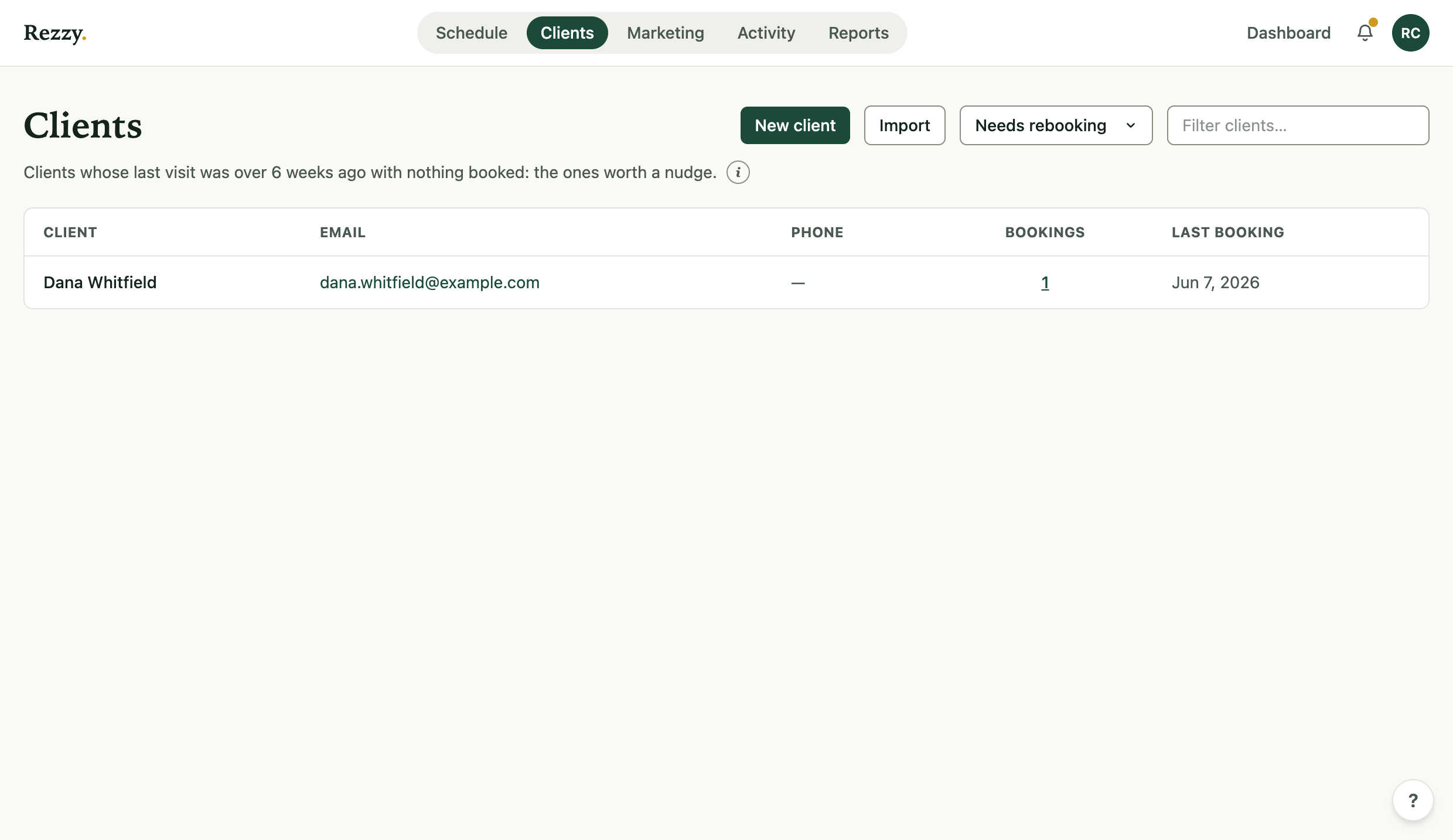 The list that replaces the marketplace: regulars you already won, caught before they drift.
Which one should you pick?
Count where last quarter’s genuinely new clients came from. If a third or more arrived through the Booksy marketplace, keep Booksy and treat Boost as your ad budget; it is doing real work. If they mostly came from referrals, Instagram, and your Google profile, you are paying marketplace prices for a calendar, and the flat-price shape fits better.
Switching takes an afternoon: export your Booksy CSV (request the full version from support on day one), import it into Rezzy with mapping and a 7-day undo, connect your processor, book yourself a test appointment, then repoint your bio and Google links. Barbershops and salons keep their regulars through a switch for a simple reason: the regulars come for you, not for the app the link opens.