TL;DR: A booking app charges a new client fee when its tracking says the marketplace found the client first and her record is missing from your client list, however long she has really been yours. Your defense comes before she books: import your whole list and use the platform’s own booking link everywhere.
You open the account activity in your booking app on a Tuesday night. The balance is lower than the week felt. Then you see it: a new client fee, with a name next to it. Danielle. You have cut her hair every six weeks for four years, and you know her kids’ names. The app has decided you just met her.
Nobody at the platform made that decision. A rule did, and the rule is public if you know where to look.
How a booking app decides who counts as a new client
A marketplace bills you when it decides it introduced the client. Fresha’s fee page lists its checks. The new client fee applies when:
- She is not on your Clients list at the time of booking.
- She “first discovers your business on the Fresha marketplace” and then books online. Fresha says it will “track the client’s online activity” to decide this.
- While booking, she confirms she has not visited your business before.
Booksy’s rule is shorter. Its Boost page says that if a client “books with you for the first time while Boost is on, you pay Booksy 30% of the total cost of the first visit, up to a maximum of $100.”
Notice what is missing from both: your history with her. The app knows its client list, its own tracking, and one answer she gave while booking. If Danielle is not on that list when she books, four years of haircuts do not count.
Four ways a regular gets billed as new
| What she did | Why the fee landed |
|---|---|
| Saw your marketplace profile, then booked on your website | Fresha counts the profile view as the discovery |
| Tapped the Book button on your own website | A Booksy owner says support told him Boost follows how the booking was completed |
| Scanned the QR code on your front desk | Owners on Fresha and Booksy report being charged anyway |
| Booked before you imported her, or walked in and was never added | She was not on your client list when she booked |
The QR code is the case owners find hardest to accept, because the client was standing in the room. One Fresha owner wrote that you are charged “the 20% new client fee even when a client scans your very own made QR code” (Capterra, March 2025). On Booksy, a US salon owner had a walk-in scan “my own Booksy QR code” to hold her slot, and the booking was “still classified as Boost” (Trustpilot, July 2026).
Another US owner had clients book through the button on his own website. “These were my followers and my traffic,” he wrote, and Booksy charged Boost on them anyway. When he disputed it, he was told Boost is “triggered based on how the booking is completed” (Trustpilot, April 2026).
Want a booking page with no fee on your regulars? Rezzy charges a flat plan price, takes no commission on any booking, and has no marketplace deciding whose client she is. Take a booking today.
What Fresha’s own pages say about the new client fee
Fresha’s rules are spread over three pages. Read side by side, they do not quite agree.
| Fresha says | Where |
|---|---|
| “No fee ever applies to your returning clients” | Pricing page |
| Clients who book through your booking links “won’t incur any New client fee charges” | Booking link article |
| The fee covers clients who “view your Fresha marketplace profile first and then choose to book through another online channel including your website or social media pages” | Fee page |
| “The Marketplace new client fee is non-refundable” | Fee page |
Checked October 6, 2026 against Fresha’s fee page, pricing page and booking link article, and Booksy’s Boost page and help center.
Put together: your booking link protects you only if she never saw your marketplace profile first, and a fee on a regular is non-refundable on paper. One owner was “charged a ‘New Client Marketplace Fee’ for a returning client who had previously booked with me,” although “I follow Fresha’s own advice by sending my direct booking link” (Capterra, July 2025). Another was overcharged £1,161.84 “due to an incorrect booking link.” Fresha acknowledged the wrong link and refunded only £241.68, as a “one-time exception” (Trustpilot, July 2026).
Booksy publishes a claim process under Marketing → Boost → Boost details. The deadline is the end of your billing period plus 7 days, and a confirmed claim is refunded within 14 business days. It is not a sure win: two US owners on Trustpilot say their Boost disputes went nowhere.
To be fair, most owners never write a review like this: Fresha holds 4.8 out of 5 on Trustpilot across more than 7,000 reviews. That is little comfort when you are the one charged.
How to stop paying a new client fee on your own clients
You cannot change how the app decides. You can change what it sees first.
-
Import your whole list before you go live on the marketplace. Fresha’s own tip is to “make sure all contact details for your existing clients are imported” before you list. On Booksy, add a walk-in “before they leave your shop.” Merge duplicate profiles too; Fresha recommends it.
-
Use the platform’s own booking link everywhere you control. On Fresha that is the Link builder; on Booksy, your Booksy Profile Link. Route your Instagram and Facebook Book buttons to it, put it on your website and business cards, and reprint your desk QR code from it. Know its limit: on Fresha, a client who saw your marketplace profile first can still be billed.
-
Read the fee lines every week. Fresha lists each charge in your business wallet as a “New Fresha client fee” with the client’s name. Booksy counts Boost clients under Boost details. Ten minutes on a Tuesday catches a misread regular while you can still act.
-
Dispute the same week, with evidence. Screenshot the booking, her visit history, and the date you first served her. On Booksy, claim inside the deadline. On Fresha, ask anyway, in writing: one owner got part of the money back once Fresha admitted a wrong booking link.
This is a business model, not a bug
A marketplace sells introductions, so it has to decide when one happened, from tracking that cannot see your front desk. The company writing that rule gets paid when an unclear case falls its way. The fee on your four-year regular is not the system failing. It is the system running.
You cannot always step off the marketplace and keep the app. Fresha says your website and social media bookings need your profile “listed on the Marketplace,” and that unlisting will “disable all your online booking channels.” Booksy’s Boost is optional, and the 30% applies only to first visits booked while it is on.
So you have two real options. Stay, and treat the import and the booking link as upkeep. Or run your own booking page, where nobody has to decide whose client she is. Rezzy is built the second way: a flat plan price, no commission, no marketplace, and payments through your own Stripe or Square, so Rezzy never holds your money.
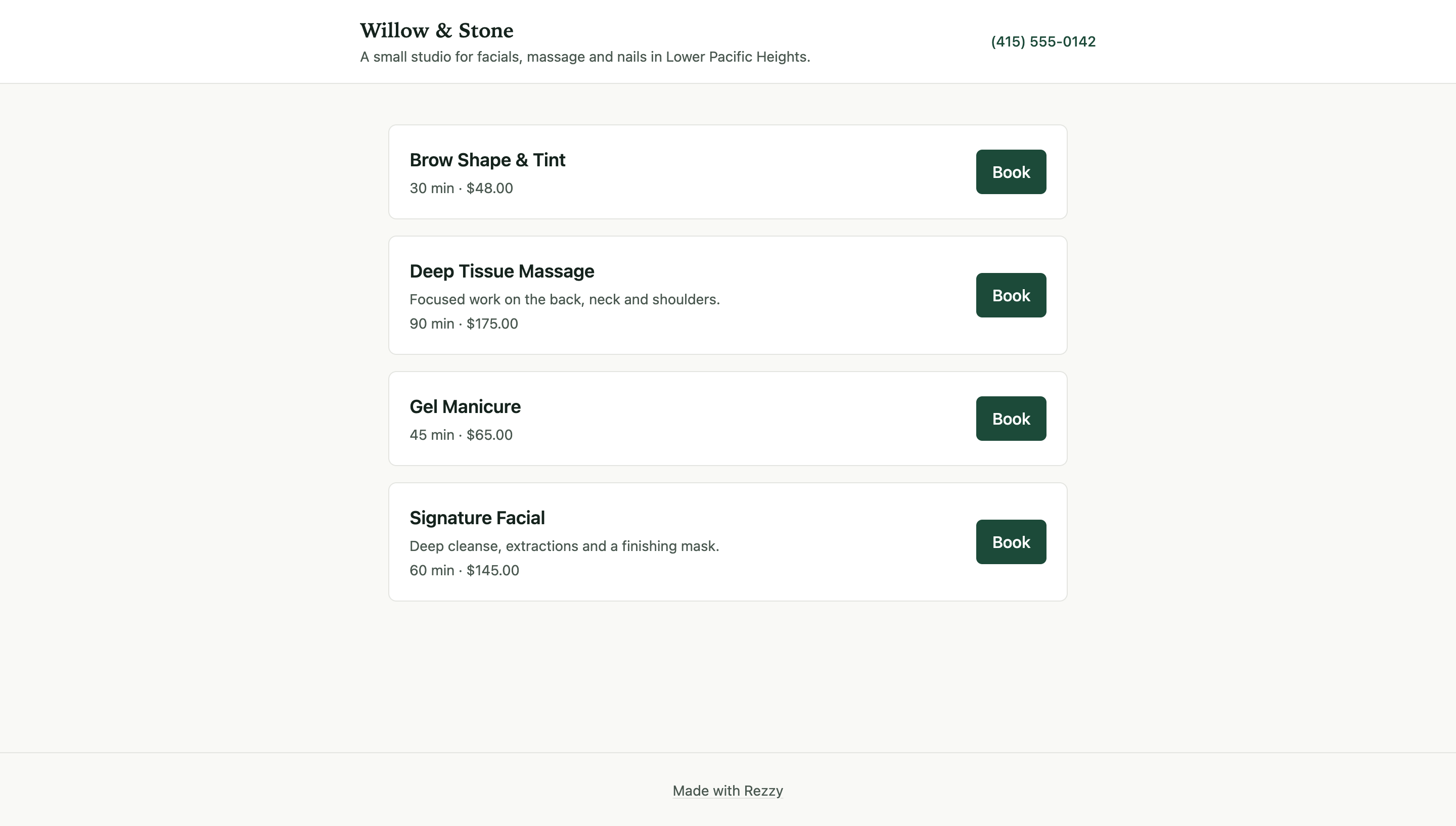
Your services, your phone number, and no other studio listed beside your name.
If you move, export from the old app first. Rezzy’s client import guesses the column mapping and can be undone for 7 days, and the export is one click on any plan if you ever leave. For the order of the move, read how to switch booking apps without losing your client list; for every fee model, read do booking apps take a cut of your sales.
Danielle was never a new client. She was a line in someone else’s revenue model, and now you know which rule put her there.