TL;DR: AI is genuinely useful to a studio in one specific way: answering questions from your own data. “What does tomorrow look like”, “who has not been in since June”, “who still owes me money” are questions your booking software can already answer, and an assistant like Claude or ChatGPT can now ask it for you. Booking platforms are taking three different roads to get there: an AI that talks to your clients, an AI locked inside their dashboard, or a connection to the assistant you already use. Keep AI away from anything that sends, charges, or cancels.
Every booking platform now has an AI announcement, and most of them answer a question you never asked. The useful question is narrow: can the assistant already open on your phone see your actual schedule and your actual client book, so its answers are about your studio instead of studios in general? Until recently the answer was no. Here is what changed, and what to do with it.
What AI can actually do for a studio
An assistant with no access to your data can draft an Instagram caption, rewrite a policy paragraph, or brainstorm a promotion. Useful, generic, and already covered everywhere.
The work that actually eats your week is different. It is questions: is Thursday full, which regulars are drifting, how did this month compare with last, who walked out without paying the balance. Your booking software holds every answer, but each one costs you a login, three taps, and a report page, usually between clients with wet hands.
The genuinely new thing is an assistant that answers those questions in one sentence, because it can look. Not an AI that guesses about salons in general. Your calendar, your client book, your numbers.
The three roads booking platforms are taking
| Approach | Who talks to the AI | Example | The catch |
|---|---|---|---|
| AI receptionist | Your clients, by phone or text | Fresha’s AI Concierge, $99.95 per location per month | It answers their questions, not yours |
| AI inside the dashboard | You, inside their app | Square AI, in beta | Another chat window to learn, locked to one platform |
| Your own assistant, connected | You, in the assistant you already use | Rezzy, through MCP | You bring the assistant; ChatGPT needs a paid plan for connectors |
The third road runs on MCP, an open standard introduced by Anthropic in 2024 that has since been adopted across the industry. It is the plug that lets Claude, ChatGPT, and most serious AI tools connect to outside software. Open matters here: you are not learning a platform’s house chatbot that dies when you switch software. You are teaching the assistant you already pay for to see your studio, and your data stays yours either way.
What asking your own calendar looks like
Connect once, then ask in plain language:
- “What does tomorrow look like?” Your bookings and blocked time, in order, in your timezone.
- “Who has not been in since June?” Your lapsed regulars, with last visit and whether anything is on the books, the same list your rebooking screen shows.
- “How did last month compare with the month before?” Visits, revenue, no-shows, new against returning, side by side.
- “Who still owes me money?” Every visit with an open balance, oldest first, so you can send the payment link from Rezzy.
The assistant reads your services, hours, and timezone first, so “Tuesday” means your Tuesday and prices come back in dollars, not database rows.
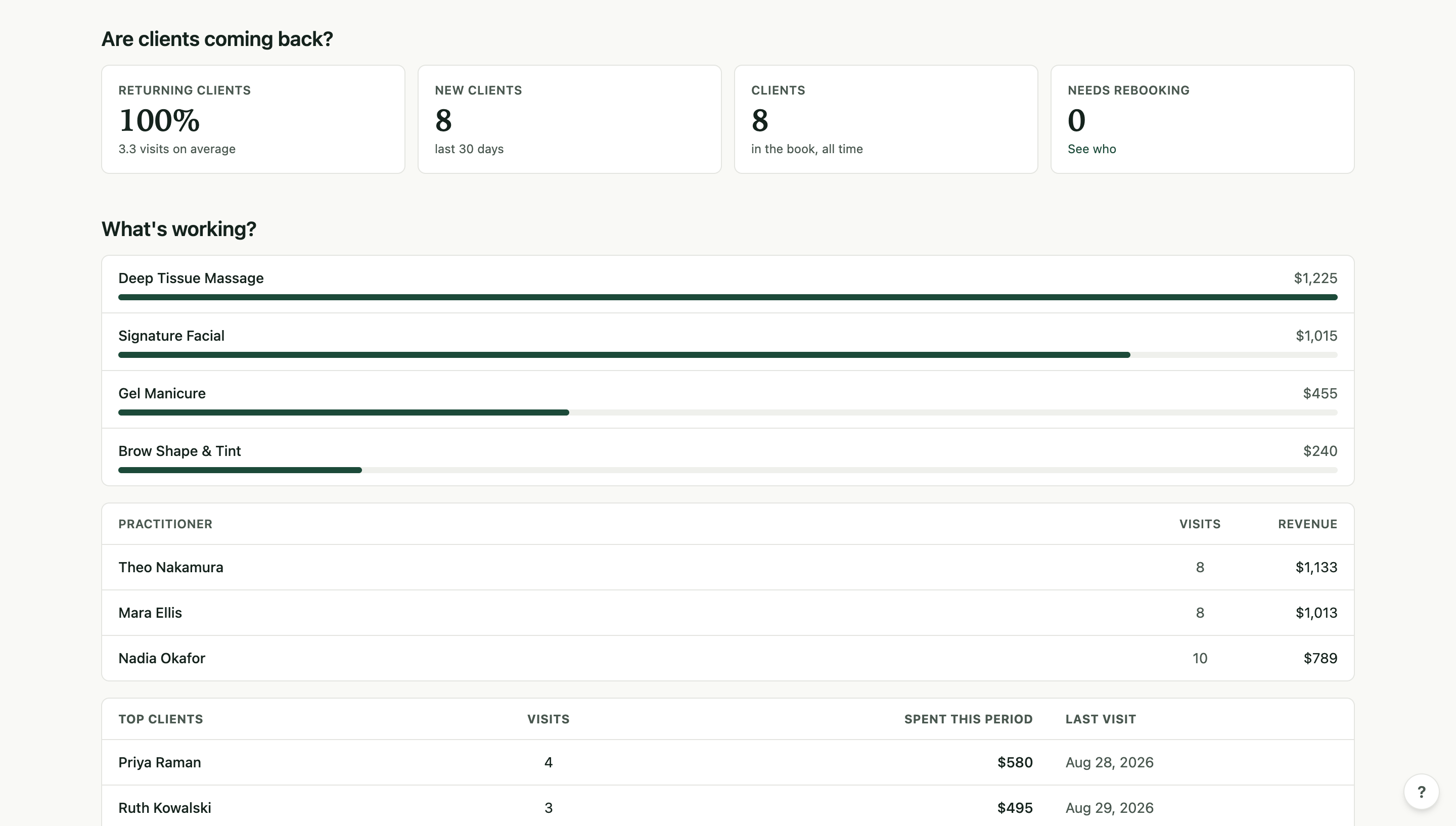 The data the assistant is reading from. Ask “how did last month compare” and this is where the answer comes from.
Want to try it on your own studio? Rezzy speaks MCP on every paid plan: connect Claude or ChatGPT with your Rezzy sign-in and ask away. It can even pencil in a booking, and the client hears nothing until you press send. Take a booking today.
What to keep AI away from
Rezzy’s connector draws one deliberate line: the assistant can look things up and pencil things in, but nothing it does can reach a client. A booking it creates sends no email and no text until you press Send confirmation in Rezzy. We think that is the only honest design in 2026. An assistant that can act on a client, send the email, charge the card, cancel the visit, can hurt a real person the moment it misreads a name. Assistants still misread names.
So no AI, ours included, should currently be:
- Messaging your clients unsupervised. A wrong message to a regular is a relationship cost no time saving covers.
- Charging or refunding anything. Money mistakes at a small studio are personal, and personally awkward.
- Cancelling or moving bookings on its own. A hallucinated conflict becomes a real empty chair.
The pattern that works: the assistant finds, summarizes, and drafts; you press send, in software built for the action.
Is it safe to connect?
Fair question, and it has concrete answers rather than reassurances. With Rezzy’s connector, every connection belongs to one person and sees exactly what that person sees in Rezzy: a team member’s assistant sees the schedule and client book, never the revenue. Every request is logged, so you can always see precisely what your assistant was shown, and logs delete after 90 days. Disconnecting is one click in Settings, and takes effect immediately.
One boundary to understand: what you type into Claude or ChatGPT is governed by your agreement with Anthropic or OpenAI, same as before you connected anything. The connection changes what your assistant can look up, not where your conversations go.
How to connect yours
Three steps, no code:
- In Claude or ChatGPT, add a connector with the URL
app.letsrezzy.com/mcp. - Sign in with your Rezzy login and click Allow.
- Ask “what does tomorrow look like?”
The step-by-step guide covers every assistant, including the token setup for developer tools, and the connector page explains what it can see in plain words. If you are not on Rezzy yet, the whole thing works on every paid plan, with your studio’s health check a good first question to ask.