TL;DR: The best salon booking software gives every stylist their own schedule, takes online bookings and deposits automatically, sends reminders without you lifting a finger, and builds a client history that doesn’t need manual upkeep.
If you’re a solo stylist or run a chair-share or small team, you’re not shopping for what a 40-location franchise needs. You’re shopping for something that stops the no-show bleeding, keeps two or three stylists from double-booking the same chair, and remembers who your clients are so you’re not starting from scratch every visit. This guide walks through what actually matters, what to skip, and how the common options stack up. (Rezzy, homepage here, is built around this exact list, and we’ll say so plainly where it applies.)
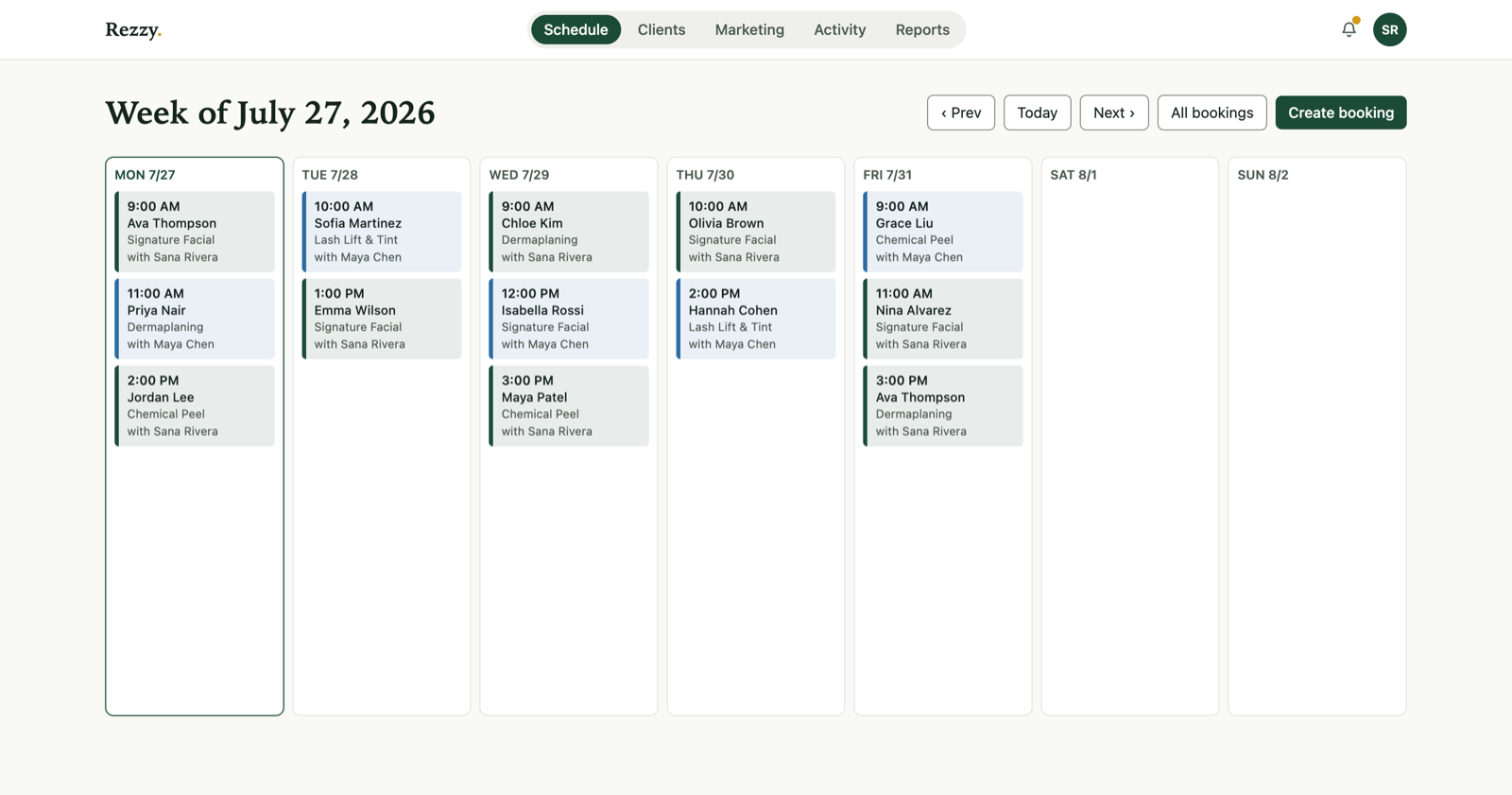
A week across every stylist in Rezzy.
What does a small salon actually need from booking software?
At minimum: a booking page clients can use without calling, calendars that respect each stylist’s hours, automatic confirmations and reminders, and a record of what each client has had done. Everything past that is worth paying for once the basics work, not before.
The checklist, roughly in the order each item starts paying for itself:
- Public booking page or widget clients can use from Instagram, your website, or a text link.
- Per-stylist availability so the software won’t book Maria into Jess’s 2pm.
- Automatic confirmations, reminders, and calendar sync so nobody has to manually text every client.
- Client history (visits, notes, contact info) that builds itself from bookings instead of a paper book or a spreadsheet.
- Deposits or card-on-file for services where no-shows actually hurt (color, extensions, bridal).
- Rebooking and review prompts so retention doesn’t rely on you remembering to ask.
- Reports simple enough to check in two minutes between clients.
Notice what is missing: inventory, retail POS, franchise reporting, loyalty points. Real features, built for a different business than a salon with one to five chairs. Paying for them buys you a heavier product, not a better one.
Multi-stylist scheduling: what to actually check before you buy
The number one failure mode in salon software is a calendar that treats “the salon” as one resource instead of several stylists with separate hours. If a tool can’t give each stylist their own working days, their own hours, and their own bookable services, you’ll spend your first month manually untangling double-bookings.
When you’re evaluating multi-stylist scheduling, ask:
- Can each stylist set their own weekly hours, independent of the salon’s general hours?
- Can a service be restricted to specific stylists (not every stylist cuts color, not every stylist does lash extensions)?
- If a client books “any available stylist,” does the system actually load-balance, or does it always default to whoever’s listed first?
- Does one stylist’s Google Calendar appointment (a dentist visit, a personal errand) block their salon booking slots automatically, or do you have to block it by hand?
A tool that only supports “one shared calendar for the whole business” will work for a solo stylist and will start causing real problems the day you bring on a second chair. Before you fill that chair, decide whether she rents it or works for you, because the answer decides whose client book her bookings fill.
Online booking page vs. embeddable widget: which do you need?
You need both, from one setup rather than two products. The standalone page is what you link from your Instagram bio, Google Business Profile, and texts. The widget drops that same flow into your own website so clients never leave it. Rezzy’s online booking does both from one service setup, so there is no second calendar to maintain.
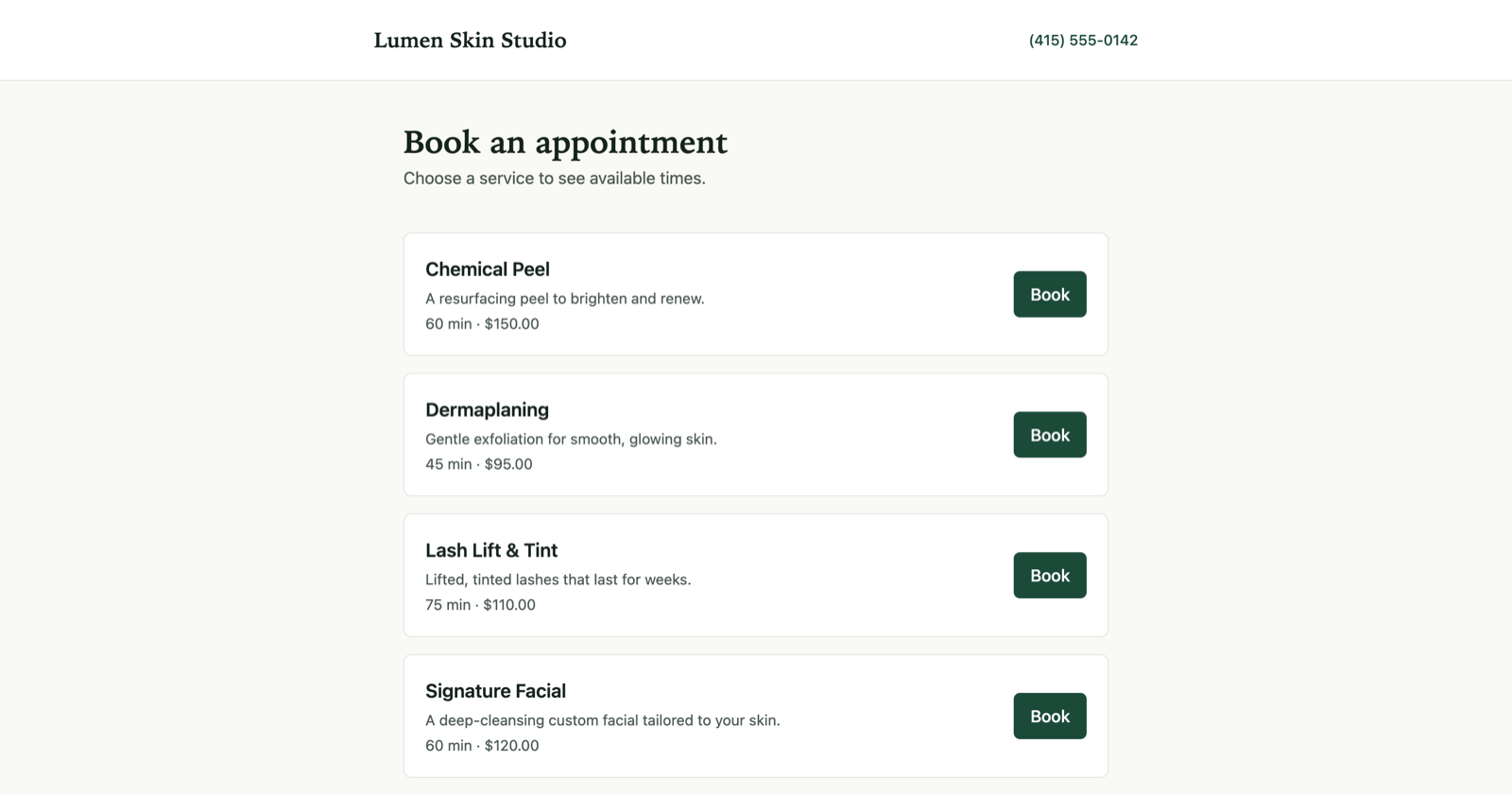
A booking page on its own link: every service with its length and price, and a Book button.
A platform offering only one leaves you either sending traffic off your own site or losing the shareable link. Neither is a dealbreaker, but it signals a lighter tool than you will want in a year.
Do I need deposits or card-on-file for a small salon?
Not for a standard cut or blow-dry. Yes for color, extensions, anything over roughly 90 minutes, and bridal or event bookings, where a no-show costs you half a day of chair time. First-time clients sit in between, and a card on file is the softer version: nothing is charged unless they skip.
What matters when you are choosing software is that the deposit is collected automatically at booking, per service, not chased over text afterwards. A tool that makes deposits a step you have to remember defeats the point. The amounts and the exact wording are in how to take deposits, and the wider set of fixes is in how to reduce client no-shows.
Want deposits collected automatically? Rezzy takes bookings, deposits, and reminders off your plate. Take a booking today.
How much does salon booking software cost?
Pricing in this category generally runs three ways: free tiers with hard limits (a capped number of bookings or services per month), flat monthly plans ($20 to $40/month is typical for a small salon’s core plan, usually with a per-seat add-on for additional stylists), and enterprise/franchise pricing that requires a sales call and is built around location count, not chair count. For what per-staff pricing adds up to at one, three, five and eight people, see Rezzy vs Timely.
What to actually compare, beyond the sticker price:
- Is client messaging (reminders, confirmations) included, or a paid add-on? Some platforms nickel-and-dime SMS and email separately from the base plan.
- Does the free tier cap bookings low enough to force an upgrade fast, or is it usable long-term for a true solo stylist?
- Is there a per-seat cost for additional stylists, and is it clearly stated, or does it require sales contact?
- Can you get your money back, so you can test it against a real week of bookings before the decision is final?
Rezzy has no free trial. You pick a plan on the day you sign up and a 30-day money-back guarantee stands behind it, so a real month of clients decides it. Solo is $19/month with unlimited bookings and services and a custom booking link. Studio is $39/month with five team members included, no per-seat fees. Unlimited is $79/month with unlimited team plus the marketing suite (autopilot emails, campaigns, templates). Annual is cheaper still: while the first 30 founding spots last it is $9, $15, and $19 a month, billed once a year. No plan takes a commission on your bookings. You can see the full breakdown and start today.
What’s the difference between salon software and general appointment scheduling apps?
General scheduling tools, built for consultants and coaches, do the calendar job but do not model salon reality. The gap shows in three places:
- Staff-service mapping. A salon needs “only Maria does balayage”. A generic scheduler treats every staff member as interchangeable.
- Buffer and cleanup. Color and chemical services need processing and cleanup inside the slot, not just the service duration.
- Rebooking cadence. Salon clients return on a rhythm, 4 to 8 weeks for most cuts and color. Salon software flags an overdue client automatically. Generic schedulers have no concept of it.
One service, one provider, no deposits, and a generic scheduler is fine. Past one chair, or any color work, purpose-built software earns its keep.
What does client history actually need to include?
At minimum: contact info, every past booking (service, stylist, date), notes from past visits (formula used, allergies, preferences), and a flag for when they’re due to rebook. The best version of this builds itself automatically from bookings rather than requiring you to type client records by hand.
That last part matters more than it sounds. A CRM that requires manual data entry gets abandoned within a few weeks by a busy front desk. Client history that populates itself from every booking, cancellation, and note is the difference between a tool you actually use and one you set up once and forget. Look for automatic client matching by email or phone (so “Sarah Jones” who books twice doesn’t become two separate client records), a visible timeline per client, and a way to flag follow-up tasks tied to a specific client without leaving the booking flow. Rezzy builds this client history automatically from every booking, so there’s nothing to set up by hand.
Do I need review request automation?
Not on day one, but it is one of the highest-return additions once booking is stable. An ask sent automatically after a visit, while the experience is fresh, beats a manual ask a week later.
Two rules apply whatever tool you pick: never gate who gets asked based on how the visit went, and never incentivize reviews. Both break Google’s policies and can get your profile penalized. Good software automates the timing, not the selection (here is how Rezzy does it). The full method is in how to get more Google reviews.
Salon booking software comparison: what to weigh
| Feature | Why it matters for a small salon | What to look for |
|---|---|---|
| Per-stylist calendars | Prevents double-booking across chairs | Independent hours per staff, per-service staff restrictions |
| Online booking page + widget | Captures bookings without phone calls | Both a standalone page and an embed, from one setup |
| Automatic reminders | Cuts no-shows without manual texting | Email/SMS reminders sent on a schedule, not manually triggered |
| Deposits / card-on-file | Protects high-cost, high-no-show services | Configurable per service, collected automatically at booking |
| Client history / CRM | Retention and personalization | Builds itself from bookings, no manual data entry |
| Rebooking prompts | Keeps the calendar full without babysitting it | Automatic flag when a client is overdue to return |
| Review automation | Grows reviews without manual follow-up | Sent post-visit, no gating or incentives |
| Team seats / pricing | Cost scales with your actual team size | Clear per-seat pricing, no sales call required for a small team |
| Reports | Tells you what’s working in under two minutes | Simple dashboard, not a BI tool you need training for |
Once you have picked one, the setup itself is an afternoon: services, hours, a link to share. That walkthrough is in how to start taking online bookings.
If you run one chair, not a floor
The checklist above is written for a salon with a team. A solo tech or a single-room studio weighs the same features differently, so there is a version for each trade:
- Booking app for nail techs, where back-to-back sets and fill reminders matter more than staff rotas.
- Booking software for lash artists, where fill cycles and deposit protection carry the calendar.
- Booking software for massage therapists, where intake, buffers, and quiet rebooking beat anything flashy.