TL;DR: Buffer time between appointments is the part of the service the client never sees: the clean-down, the reset, the note, a glass of water. Time your real reset for each service, set it as a buffer after that service, and price the service on every minute it takes from your day.
It is 2:58. Your 2:00 is paying at the desk, your 3:00 is already in the doorway, and the last client’s bowl is still in the sink. You have not written her note. You have not had water since 11. From here, every client today starts five minutes late.
The fix is not working faster. It is putting the reset on the calendar, because it was always going to happen somewhere.
What buffer time between appointments is for
A buffer is the gap after a service before the next client can book. It is not slack. It is work, and it happens whether your calendar admits it or not:
- The clean-down. Tools into disinfectant, the station wiped, the bowl rinsed.
- The reset. Fresh linens, the room put back the way the next client should find it.
- The checkout. Payment taken, the next visit booked.
- The note. The formula, the pressure she liked, the wedding she mentioned. Write it now or it is gone. Rezzy keeps notes on the client’s page.
- You. Water, the restroom, one breath before you smile at the next person.
If the calendar does not hold these minutes, your lunch holds them, or your next client does.
How long should buffer time be?
Measure it. A guess is how you end up running late by 2pm.
- For one week, start a phone timer when each client stands up. Stop it when the station is ready for the next one.
- Group the times by service. A brow tint resets faster than a hot stone massage.
- Take your slowest normal reset, not the average. A buffer set to the average runs short every time a reset runs long.
- Round up to the next 5 minutes.
Then check your state board’s rules, because some resets have a legal floor. In California, after every client, the disinfectant in a whirlpool foot spa must circulate “for at least 10 minutes”, and a plain foot tub must hold disinfectant for at least 10 minutes. Each cleaning goes in a log (Article 12, sections 980.1 to 980.3). A disposable liner has its own rule (section 980.4): you throw the liner away, then scrub, rinse, dry, and log the basin. Non-electrical tools, such as nippers and combs, must be cleaned, dried, and fully immersed in an EPA-registered disinfectant, used as its label directs, before they touch the next client (section 979).
So with one basin and no liners, that basin is out of use for at least 10 minutes after every pedicure, before you count the scrub and the rinse. That is the floor for your pedicure buffer.
Checked October 5, 2026 against the California Board of Barbering and Cosmetology’s regulations. Rules differ by state; your own state board is the source of truth.
A second set of tools, or a second basin, lets the soak run during the next service. That is the honest way to shorten a buffer. Skipping steps is not.
What a buffer costs, and why you charge for it
A buffer takes appointments off your day. Here is one service, booked solid from 9 to 5:
| Service + buffer | Start times | Bookings in the day |
|---|---|---|
| 60 min + no buffer | 9:00, 10:00, 11:00 … 4:00 | 8 |
| 60 min + 10 min | 9:00, 10:10, 11:20 … 4:00 | 7 |
| 60 min + 15 min | 9:00, 10:15, 11:30 … 3:15 | 6 |
| 45 min + 15 min | 9:00, 10:00, 11:00 … 4:00 | 8 |
In that day, a 10-minute buffer costs one booking and a 15-minute buffer costs two. That is not a reason to cut the buffer. It is the real cost of the service, so put it in the price.
A $90 service that takes 60 minutes plus a 15-minute reset uses 75 minutes of your day. That is $72 an hour, not $90. Price the service on its total minutes. If $72 is too low, change the price, not the reset. Here is how to raise prices without losing clients.
The last row is a small trick: when duration plus buffer makes 60 and your hours start on the hour, every start time lands on the hour.
Want the reset on the calendar for you? Set a buffer on each service in Rezzy, and your booking page only offers times that leave room for it. Take a booking today.
Buffer, lunch, or a block: which tool for which gap
Not every gap is a buffer:
| The gap | Where it belongs | In Rezzy |
|---|---|---|
| The reset after every client | The service | Buffer after (min), under Settings → Services |
| Lunch, every working day | Your hours | Two rows for the same day in Weekly hours, under Settings → Availability (set your hours) |
| A one-off: the dentist, a VIP hold | The calendar | Block time on the Schedule page (block time off) |
| A service that keeps running long | The service length | Duration (min), under Settings → Services |
Lunch is not a buffer. A 10-minute buffer after every client never adds up to 30 minutes at noon.
How to set buffer time between appointments in Rezzy
- Go to Settings → Services and click Edit on a service.
- Enter your reset time in Buffer after (min). The field moves in 5-minute steps.
- Click Update Service, then repeat for each service (set up your services).
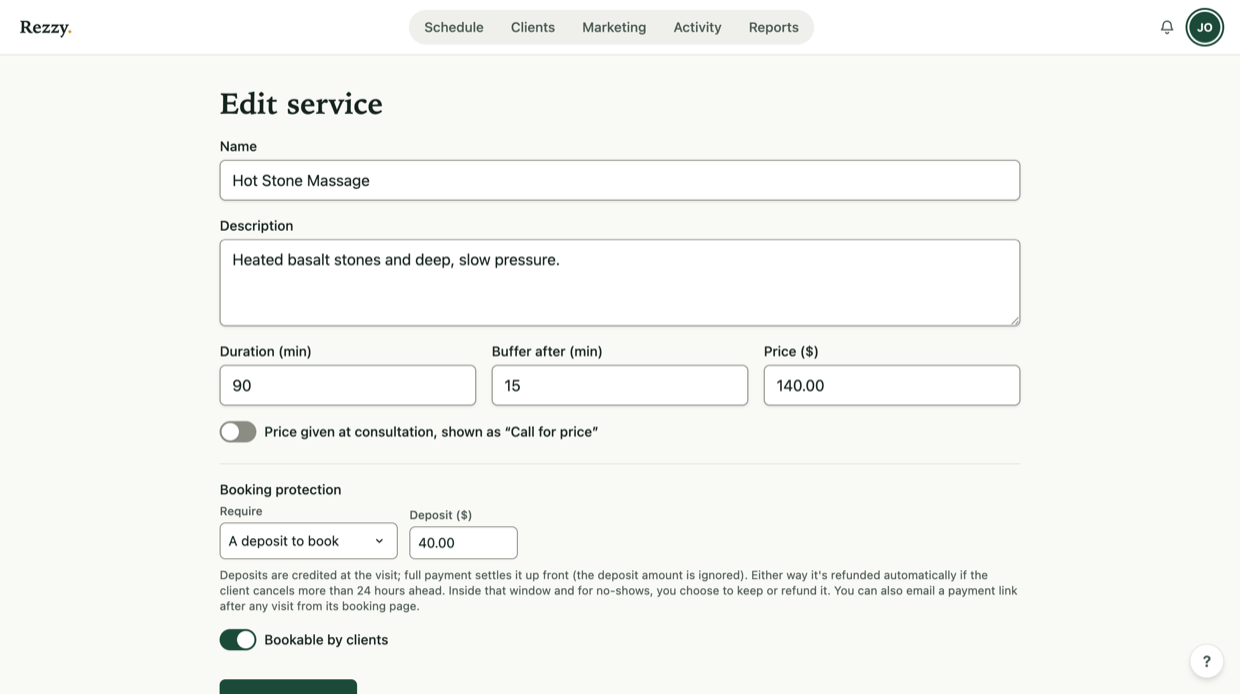
Duration, buffer, and price sit side by side on every service.
What changes once it is set:
- Clients see only the service length. The booking page says “60 min”. They cannot book into the buffer.
- Start times step by the service length plus the buffer, counted from the start of your hours. A split day restarts the count after lunch.
- The last appointment must end by closing time. Its buffer can run past it.
- Your own bookings respect it too. When you book a client from the Schedule page, you only see times that fit.
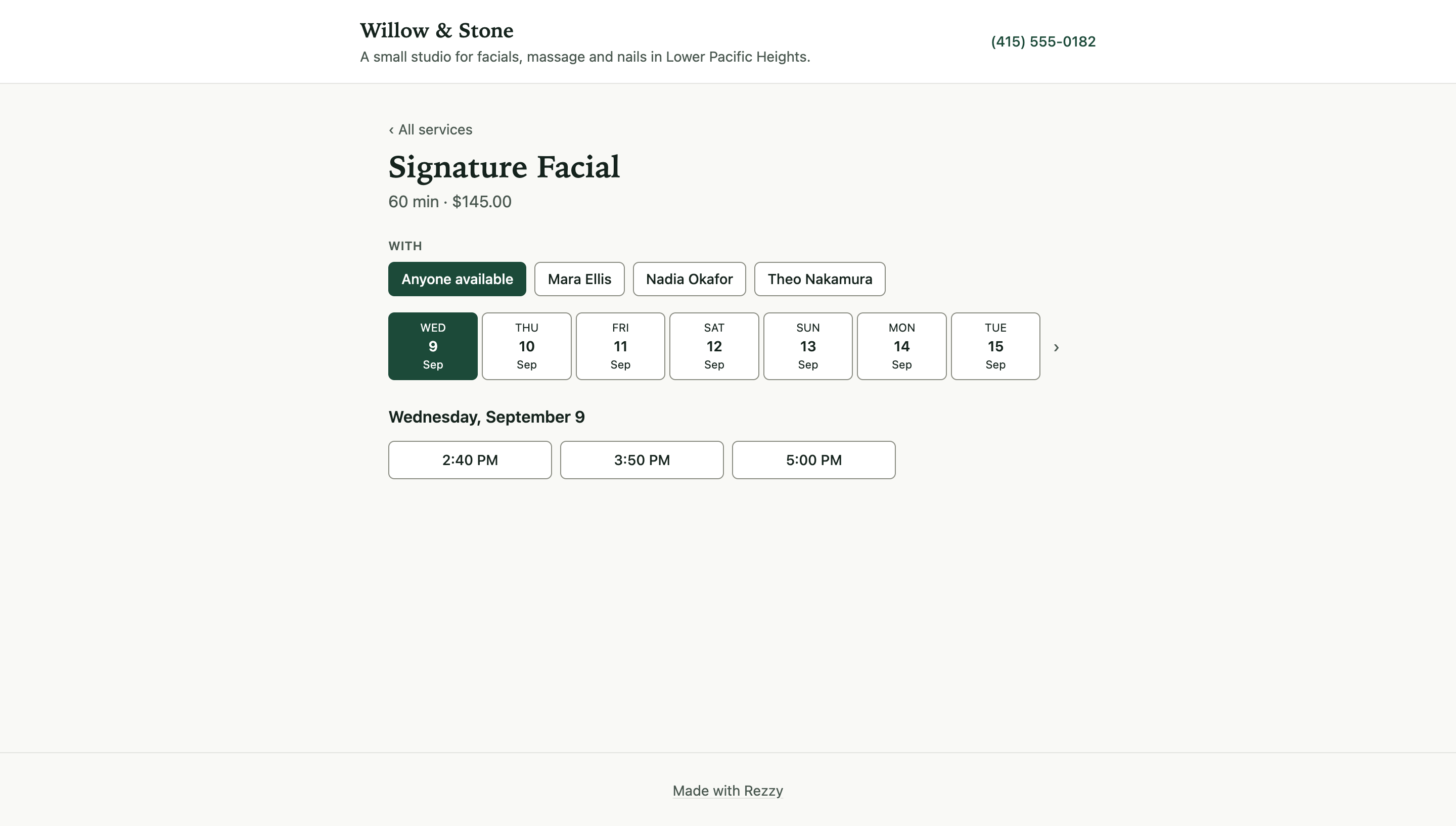
The client sees “60 min”. The start times are 70 minutes apart. The other 10 are the buffer.
There is one buffer field, and it sits after the service. If a service needs setup before the client sits down, put that time in the duration.
The Next 2 weeks card on Reports counts only service time against your open hours. If every day runs 9 to 5, booked solid with 60-minute services and 15-minute buffers, the card tops out at 75% booked. Read that as full (read your reports).
When the buffer keeps disappearing
Watch what you do with the buffer for a week. It tells you which number is wrong.
- You spend it finishing the service. The duration is wrong, not the buffer. Make the duration longer. The client sees the real length, and you stop borrowing from the reset.
- You spend it standing around. The buffer is too long. Take 5 minutes off and give the time back to your book.
- It changes with the client. Make the long version its own service with its own buffer.
Time it again when you add a service, change a product, or bring in a second person. Your reset changes when your work does.
The client never sees those ten minutes. She sees a clean room, a person who is ready for her, and an appointment that starts on time.