TL;DR: A salon referral partnership works when you pick one nearby business whose clients already need what you do, send them a client first, and never keep score. No fee per client, no tally, no swapped reviews: two owners who recommend each other by name because the work is good.
A client in your chair says she is getting married in June and asks if you know a good florist. You say, “I think there’s one on Fifth?” She leaves with half a name. A week later, a bride at that florist asks about hair, and the florist says, “I think there’s a place on Elm?”
You both just gave away a referral blind. Here is how to make it a real one, without turning it into a deal.
What is a salon referral partnership?
A salon referral partnership is an understanding between two nearby businesses that serve the same people but sell different things. Each recommends the other by name, to the client who needs it, at the moment she needs it.
It is not a coupon swap, a commission deal, or a logo on each other’s websites. Those are advertising. A referral is someone she trusts telling her where to go, and it only works while it stays a recommendation, not a sale.
Who makes a good referral partner?
A partner has to pass three tests:
- Same clients, different service. Her clients need you, yours need her, and neither of you does the other’s work. A second nail studio is a competitor, not a partner.
- Work you would put your name on. Every referral spends a little of your reputation. If you would not send your best regular there, do not send anyone.
- Close enough to walk. A name down the street, she can visit on her way home. A name across town, she has to remember.
| If you run a… | Look nearby for… | The moment her client needs you |
|---|---|---|
| Hair salon | Bridal shop, florist | A wedding date |
| Barbershop | Tailor, menswear shop | A new suit, a job interview |
| Nail studio | Lash and brow studio, bridal shop | An event weekend |
| Lash and brow studio | Hair salon, portrait photographer | The week before photos |
| Massage studio | Yoga or pilates studio, running store | A new class schedule, a first race |
One partner you trust beats five you met once. Start with one.
Why do referral partnerships quietly fail?
Someone starts counting.
It begins warm: “Let’s send each other clients.” Three months later one of you has sent six and received two, and every slow week reads like a debt. Nobody mentions it again.
| The deal that fails | The version that works |
|---|---|
| A fee for every client you send | Nothing changes hands but clients |
| A tally: “I sent you five, you sent me two” | You send when it fits the client |
| A stack of discount cards by the register | One card, handed over by a person |
| “I’ll send when you send” | You send first, and keep sending |
| Trading Google reviews | Each of you asks your own clients |
The fee fails for a second reason. The FTC says a recommendation is covered by the FTC Act when a business “pays you or gives you something of value to have you mention” its product. Its Endorsement Guides add that a connection “a significant minority of consumers wouldn’t expect,” one that “would affect how they evaluate the endorsement,” “should be disclosed clearly and conspicuously” (FTC endorsement guidance). In plain words: if you pay your partner per client, and some of her clients would not guess it, she should tell them. A recommendation that starts with “I get paid if you go there” is not the warm one you were paying for.
The review swap fails outright. Google’s Maps content policy bans reviews “paid for, directly or in kind,” and content “based on a conflict of interest,” which can include “professional or personal affiliations.” A review traded for a review fits both. Ask your own clients instead, the way you would ask for any Google review.
Checked October 5, 2026 against the FTC’s endorsement guidance and Google’s Maps content policy. The links are the source of truth.
Want a link worth handing over? Rezzy gives you a booking page with your services, your prices, and your real open times, so a client can book the minute she hears your name. Take a booking today.
How do you start a referral partnership without it being awkward?
Become a customer first, then send first, then talk.
- Book their service, or buy something. Know firsthand what you would be recommending. If it is not good enough, stop here.
- Send a client before you ask for anything. Send her by name, then tell the owner: “I sent Maya your way for her wedding flowers.”
- Then have the short conversation. In person, at a quiet hour, never in the middle of her Saturday.
Say it out loud, or leave it as a note:
Hi [name], I’m [your name] from [studio], down the street. I sent [client] to you last week for [her need], and I’ll keep doing that whenever it fits.
My clients ask me about [their service] all the time. If any of yours ever need [your service], here’s my card.
No deal and no fees. Just two names we both trust.
Then agree on three things, and nothing more: what each of you does best (“bridal hair, not color corrections”), whose name to give, and how a client books.
What should you hand your partner?
One card with your name, one line about what you do, and a QR code for your booking link. Not a stack of coupons.
In Rezzy, the link is under Settings → Booking page, next to Copy link (set up your booking page). Make a QR code from it, print it on the card, and test it with your own phone. It is the same card that sits on your own front desk.
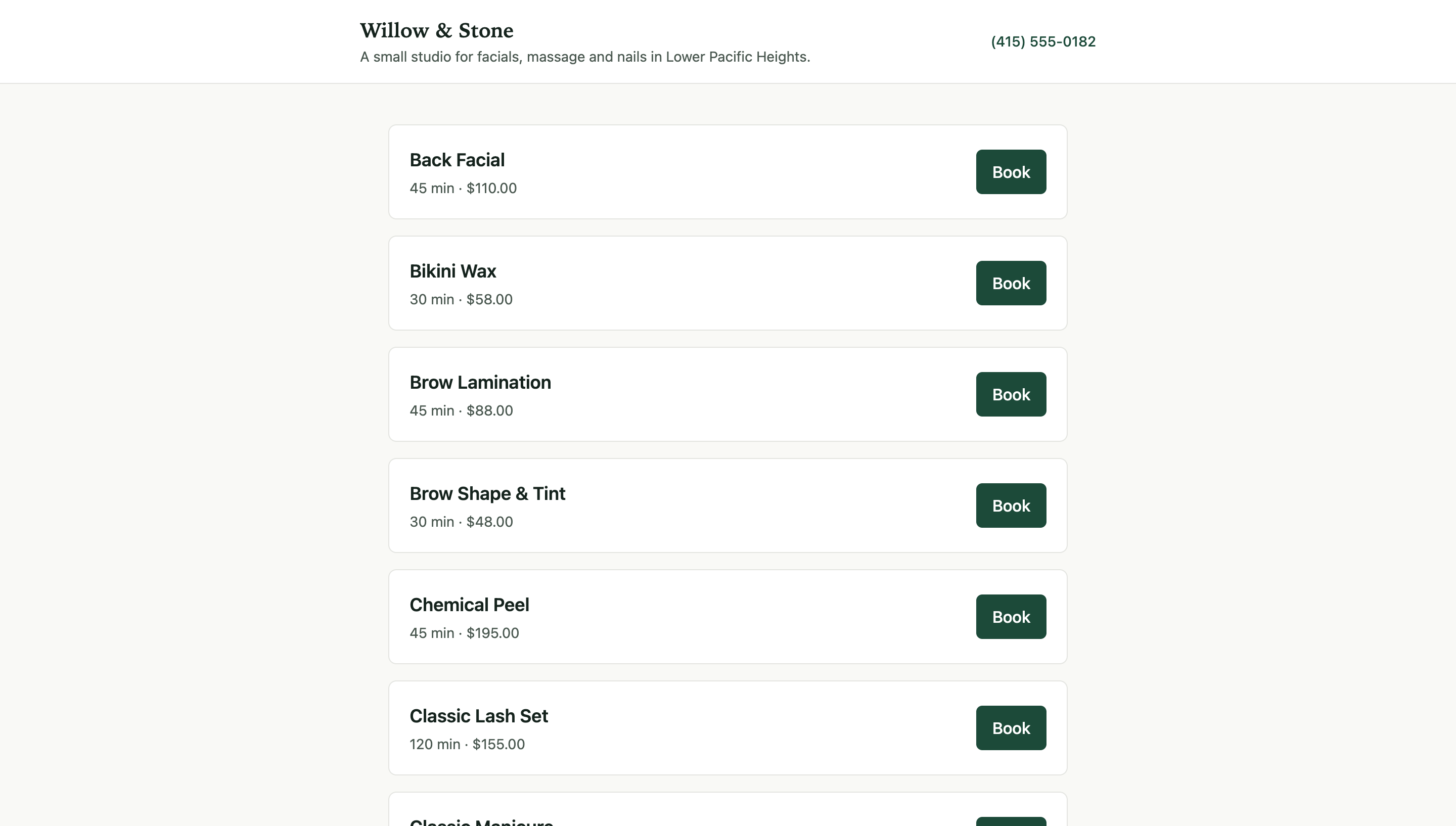 What the card should open: your services, your prices, and a Book button on each one.
Better than a card: when her client says yes, your partner texts her your link on the spot. She books while she is still at the counter. Do the same when you send someone: say the name, say why, text the link.
How do you know it is working without keeping score?
Notice. Do not count. At every first visit, ask “How did you hear about us?” and write the answer where you will see it again.
In Rezzy, open her client page and choose Actions → Add a note: “Sent by Dana at the florist on Fifth.” Or open Edit and add a tag for the partner. The search on the Clients page reads tags, so typing a tag like “florist on fifth” lists everyone the partner sent (client notes and tags).
Use it for one thing: thank-yous. “Thank you for sending Priya my way” tells your partner the referral landed, and it costs you one text.
Never send your partner a list. A list turns the thank-you back into a tally. And never share your client list with them: her yes to your emails is not a yes to theirs (how marketing consent works).
What to do when a referral goes wrong
Sooner or later a client you sent comes back unhappy. The flowers were late. The suit did not fit. What you do next decides whether the partnership lasts.
- Tell your partner, privately, once. Give the facts, without heat. A good owner wants to know.
- Tell the client you passed it on. She trusted your name. Show her it meant something.
- If it happens again, stop sending. Quietly. Your name is the only thing you were ever lending.
And when your partner comes to you about a client you got wrong, thank them. It means the partnership is real.
Want the wording for asking clients? Our referral request email templates cover the ask, the thank-you, and a simple reward.