TL;DR: A healthy salon rebooking rate is one you have actually counted, read over at least two of your service cycles, and rising or holding month after month. The 70 percent you hear quoted is a target, not a measured average, so count your own first: of today’s finished visits, how many left with the next one booked?
Ask a studio owner what share of her clients rebook, and the answer comes fast: “Most of them.” She is picturing her Thursday regulars, the ones who book six weeks out before they stand up. The client who came once in March and never came back does not come to mind. That is why the guess runs high.
Here is how to count the real number in a week, what healthy looks like, and what a low number is telling you.
What does “rebooking rate” actually mean?
Three numbers go by the same name. Each answers a different question, so pick one and keep it. A rate that changes its definition every month tells you nothing.
| Number | What it counts | The question it answers | Where it lives in Rezzy |
|---|---|---|---|
| Prebook rate | Share of finished visits where the client left with her next visit booked | Did she leave with a date? | Not on Reports. Count it by hand |
| Return rate | Clients seen in a period who came back at least once more in that same period | Do clients come back at all? | Returning clients |
| Lapsed count | Clients past your rebooking window with nothing booked | Who is slipping right now? | Needs rebooking |
The prebook rate is the one to count first, because it measures the moment you control: checkout. The other two show the result of that moment weeks later.
What is a healthy salon rebooking rate?
A target you will hear often is 70 percent. The bluntest version is a salon coaching firm’s pre-book scale, which rates 70 to 80 percent as “Excellent. Systems are working” and says “there is no acceptable reason” for a pre-book rate below 70. The page gives no sample and no method. It is a coach’s target, not a measured average.
Look for an average and the figures disagree. The ones we checked ran from 30 to 57 percent, and the highest was for New Zealand hair salons, on data from 2017 to 2020. Each came either from a software company describing its own customers or from a survey we could not trace to its source. We found no measured benchmark for US studios with a stated sample and method.
Checked October 6, 2026, against the coaching firm’s page and the sources behind the lowest and highest averages.
So treat 70 percent as a direction, and judge your own number on three tests:
- It is counted, not remembered. A guess leaves out the clients you have already lost.
- It fits your cycle. A return rate read over a window shorter than your rhythm will look broken when nothing is wrong.
- It moves the right way. Measured the same way each month, it rises or holds. That trend is the one benchmark about your book.
Want two of the three counted for you? Rezzy builds your client book from every booking, counts who comes back, and keeps a live list of who is past due. Take a booking today.
How to count your rebooking rate in one week
You need a notepad and five minutes at close. Do this before you try to fix anything.
- Write your guess down first. One number. You will want to know how far off it was.
- At close each day, list every finished visit. Skip no-shows and cancellations. They are a different leak.
- Next to each name, write yes or no: does she have a future booking right now? A standing appointment counts as yes.
- Star every first visit. One blended number hides which group leaks.
- After a week, divide. Yeses over visits is your prebook rate. Then do it again for the starred names alone.
- Keep the rule fixed. A client who books by text tomorrow is a no today. That is the point: the number measures checkout.
If the week was slow, count two before you trust the number.
What Rezzy’s Reports page shows
Open Reports and scroll to Are clients coming back? Two of its four cards answer the rebooking question. The guide to reading your reports covers the whole page.
- Returning clients takes everyone with at least one completed visit in the date range you picked and shows the share who had two or more. Under it, visits on average is completed visits per client seen in that range.
- Needs rebooking counts clients whose last completed visit is older than your rebooking window and who have nothing booked. It ignores the date range: it is always today’s list, and See who opens it.
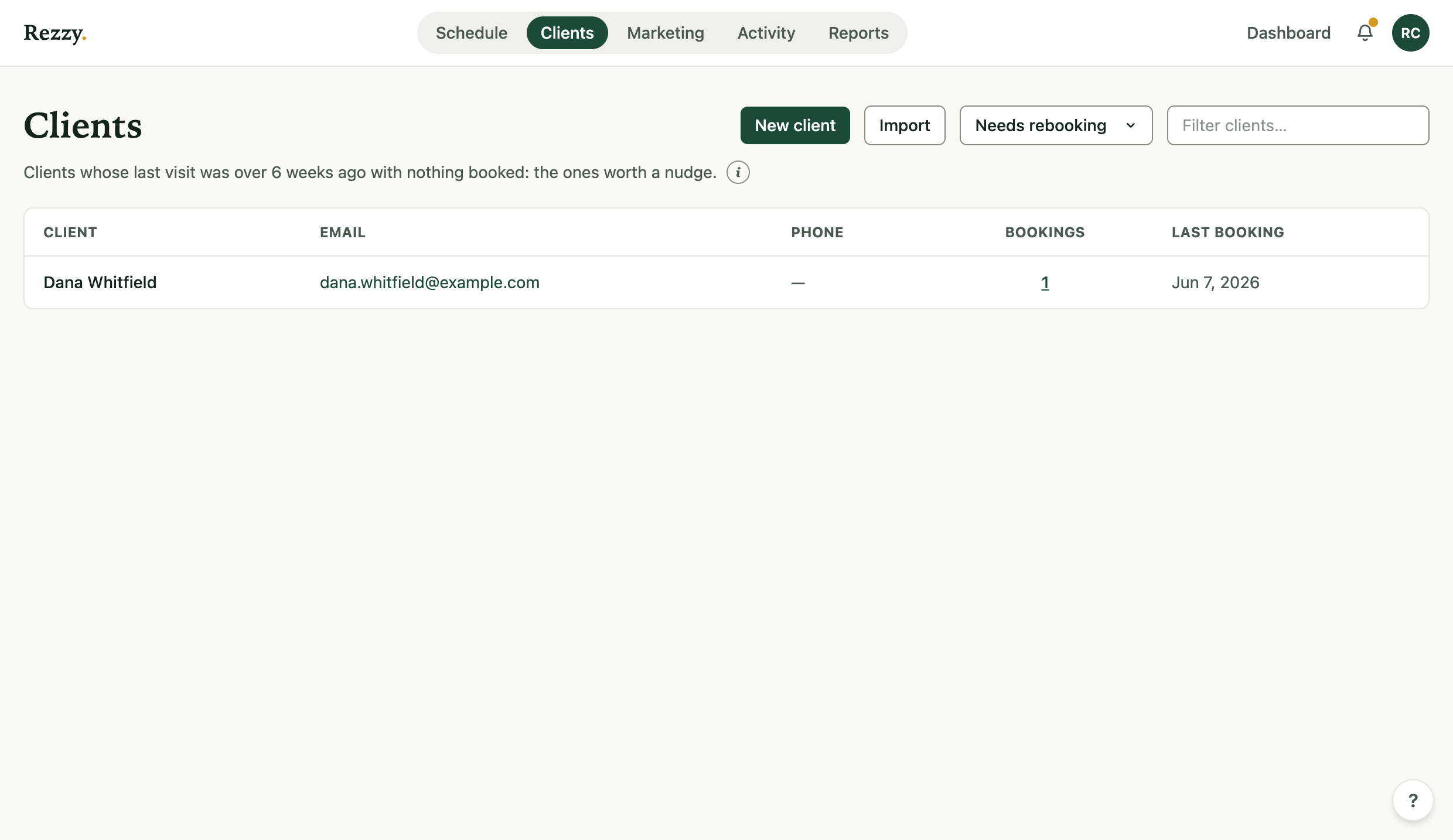
Needs rebooking: last completed visit past your window, nothing on the books.
Two settings decide whether those numbers are true.
The date range. Reports opens on Last 30 days. A client on a six-week rhythm cannot visit twice in 30 days, so Returning clients reads low there even when every regular is on time. Set the dates to cover at least two of your cycles, three to be safe: about three to four months for a six-week rhythm. Then compare visits on average with what a regular on rhythm makes in that range, about three in 18 weeks on a six-week cycle. The gap is new clients and regulars who slipped.
The marks. Only visits marked completed count. A past visit you never marked waits as Not marked, and Reports does not count it as a visit. Mark as completed or Mark as no-show at close (how each one works).
The rebooking window is Lapsed after (weeks) in Settings → Booking page. It is six weeks until you change it. Set it to your real cycle, or the list nags too early or too late (set your rebooking window).
What a low rebooking rate is telling you
A low number is a symptom. Read it next to the others before you act.
| What you see | What it usually means | First move |
|---|---|---|
| Returning clients low on Last 30 days, normal over four months | The range is shorter than your cycle. Nothing is wrong | Read the longer range, the same one every month |
| Many past visits still Not marked | Reports is undercounting | Mark every visit before you leave |
| Hand-count prebook high for regulars, low for first visits | First visits leave without a next date | Offer the next date at every first-visit checkout |
| Needs rebooking grows month over month | Regulars drift past their cycle | Work the list weekly with a rebooking text |
| Returning clients fine, Booked ahead thin | Clients come back, but book late | Ask at checkout, and put regulars on a standing appointment |
Clients gone six months or more need a different message than a due-back nudge: one win-back email that leads with news, not with how long she has been gone.
Fix one leak, then count again
Pick the row that fits and change one thing for four weeks. Change the checkout script, the rebooking window, and your reminder texts in the same month, and you will never know which one moved the number.
At checkout, offer a specific date, not an open question. “Same time in six weeks? That’s Thursday the 12th at 5” gives her a yes to say. “Do you want to book your next one?” gives her an easy “let me check my calendar.”
Then count again with the same rule, over the same length of range. Write three numbers on one line with the date: your prebook rate, Returning clients, and Needs rebooking. Twelve lines from now, you will know your studio’s healthy rebooking rate. No benchmark can tell you that.